Old English Paintings: William Hogarth, Reynolds and the 18th Century
For most of its history English painting was done by foreigners. Holbein was German, Van Dyck Flemish, Lely Dutch, Kneller German again. The court hired abroad because there was no native school worth hiring. The old English paintings that changed this were made in the middle of the eighteenth century by a generation that decided to stop apologising, and the argument they were making is visible in the pictures themselves.

A scene from a ballad opera, painted as though it were a history picture. Hogarth is claiming the same seriousness for English theatre that Italian painting claimed for myth.

Reynolds paints himself at work and shades his eyes against the light he is painting by.

The second scene of six. Everything in the room is evidence: the overturned chair, the steward's unpaid bills, the clock.
Old English paintings and the famous English artists who made them
The famous English artists of this period were working without an institution behind them. There was no academy until 1768, no reliable public exhibition before 1760, and no market for anything except portraits. A painter who wanted to make history pictures, the highest category in every European theory of art, had nobody to sell them to. This is the constraint that shapes all the old English paintings of the century, and understanding it explains a great deal that otherwise looks like simple provincialism.
The response was to smuggle ambition into the categories that did sell. Hogarth's answer was the narrative series; Reynolds's was to paint portraits that borrowed the poses of classical sculpture and Renaissance altarpieces, so that a sitter in a modern coat carried the weight of an antique statue. Both were arguments about what English painting was allowed to be, conducted in paint because there was no other forum for them.
William Hogarth and the modern moral subject
William Hogarth invented a category to sit in the gap. He called it the modern moral subject: a sequence of pictures telling a story of contemporary life, engraved and sold by subscription so that the money came from print buyers instead of patrons. Marriage A-la-Mode is the best of them. A merchant's daughter is married to an earl's son to trade money for rank, and the six scenes follow the arrangement to its conclusion.
What makes the series work is that William Hogarth trusted the viewer to read. Nothing is captioned. The information sits in the props: the steward leaving with a fistful of unpaid bills, the dog finding a woman's cap in the husband's pocket, the clock showing an hour that shames both of them. He was also, in The Beggar's Opera, willing to paint a scene from a popular musical stage show at the scale and with the compositional seriousness normally reserved for scripture.
English portrait painting as a business
English portrait painting in the 18th century was an industry with a price list. Rates were quoted by size and by how much of the sitter appeared: a head, a half-length, a three-quarter, a full-length with landscape. A successful painter ran a studio with assistants for drapery and background, and the master's own hand might account for the face alone. Thomas Gainsborough worked inside that trade while complaining about it, and is treated separately.
Reynolds, who understood the business better than anyone, used it against itself. His portrait of the fourth Earl of Dunmore in Highland dress is a full-length with a landscape, the most expensive option, and the tartan and the mountain do work that a plain interior could not. Gainsborough, working the same market from Bath and then London, kept complaining in letters that he wanted to paint landscapes and was obliged to paint faces. The famous English artists of the age were, in plain commercial fact, face painters. English portrait painting paid for everything else that happened in the century.

A full-length with landscape: the top of the price list, and the tartan earns it.

The sitters occupy the left third. The rest is their land, painted with more evident pleasure than they were.
The 18th century conversation piece
The conversation piece is the 18th century's most English invention: a small informal group portrait, figures at full length in a room or a landscape, caught doing something, not posing. Gainsborough's Mr and Mrs Andrews is the famous example and an odd one. The couple sit at the edge of their own picture while the Suffolk cornfield takes the centre, and the sheaves and the oak are painted with an attention the sitters do not quite receive.
That imbalance is the most honest thing in the century's English art. The picture is about property. The gun, the land and the marriage are the subject, and the two people are the means by which those things are held. A century later the Pre-Raphaelites would look at this tradition, decide it had gone soft, and reject the whole of it in favour of what came before Raphael.
Two centuries of English painting on one line
Set the two halves of the story against a single scale and the argument becomes a matter of dates. Hogarth is dead four years before the Royal Academy opens its doors. Reynolds, who presides over it, is painting in the Grand Manner while Gainsborough is putting a Suffolk cornfield behind a pair of landowners. And the Brotherhood forms in 1848, eighty-four years after Hogarth's death, at a distance from him that is easy to lose in prose.
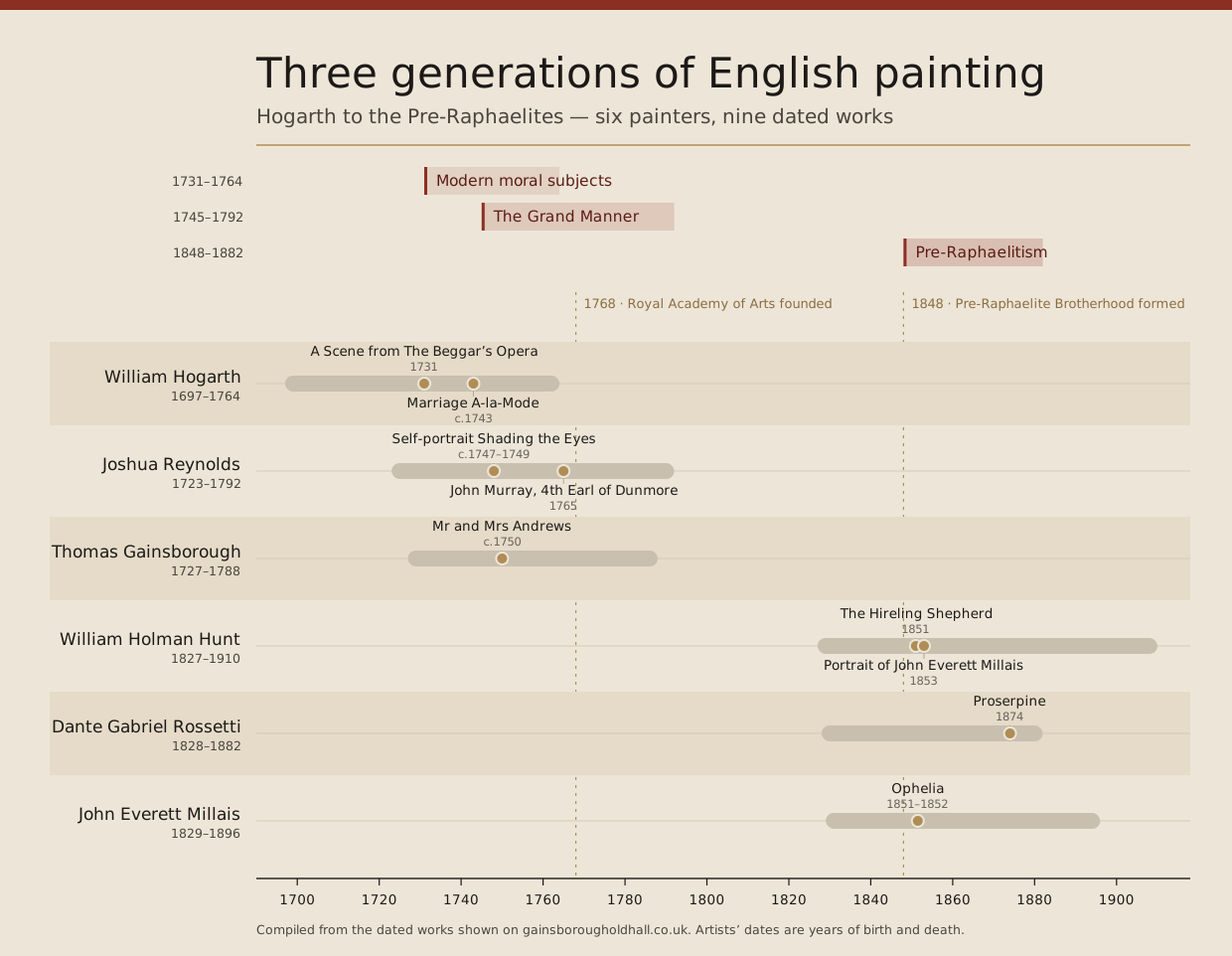
Painting dates are those given with each work on this site; the two dashed lines mark the founding of the Royal Academy in 1768 and of the Pre-Raphaelite Brotherhood in 1848.
Embed this graphic
Questions about English painting of the period
Why are there so few English painters before 1700?
Because the Reformation removed the largest employer. Religious painting had sustained workshops across Europe; in England that work stopped, and what remained was portraiture for a court that preferred to hire from the Low Countries and Germany.
What is a modern moral subject?
Hogarth's own term for a sequence of paintings telling a contemporary story with a moral shape, sold to the public as engravings. A Rake's Progress, A Harlot's Progress and Marriage A-la-Mode are the principal series.
Did Reynolds and Gainsborough get on?
Not particularly. They were the two leading portraitists of the same market, with opposite methods: Reynolds theoretical and learned, Gainsborough intuitive and impatient with theory. Reynolds nonetheless gave the fourteenth Discourse to Gainsborough's memory.
Where can these paintings be seen?
The National Gallery in London holds Marriage A-la-Mode and Mr and Mrs Andrews. Tate holds a large part of the Hogarth collection. The National Portrait Gallery holds much of the portrait material.